
How does one recapture two weeks' worth of adventure in a short time? In my last blog, I had just met up again with Marie-Josephine, or Marie-José as we call her, and Michel. At Santhià, we met a pilgrim on bike, an italian named Dennis. He's an architect and helped us immensely by translating for us as we ordered dinner.
In Vercelli, we met two other italian pilgrims on bike, Ermanno and Hugo. They were great fun and cooked us a delicious pasta dinner. We also arrived in time to eat lunch with the priest (whose name was Alberto, not Roberto as previously reported). Very kind man.
Sunday morning, we rose early, went to the church to pray with Father Alberto and continued on our way. We had clear skies! Yay!
We knew it was going to be a great day when a young woman on bicycle shouted a "Bravi!"at us early in the morning. We had no idea just how many gifts God would send us in that one day!
In Pastrelo, a woman saw M-J and I (Michel walks much faster), and wanted to bless us with a cup of espresso, which we gratefully accepted, of course. When we arrived at Robbio, where M-J and I had planned to take the train, the conductor let us ride for FREE. At Mortara, our destination for the day, we were met with bad news. Though we had called and reserved 3 beds, the custodian would not let us in at the Abbey. We were tired, HOT, and did not know what else to do. So we sat down in the Abbey grounds as the mosquitos ate Marie-Jose for dinner, when we decided to pray and believe that God would provide. After all, he had already blessed us with many other gifts, we knew he would take care of us.
No sooner had we finished praying when Roberto and Donnatella Stefani arrived, walking

through the abbey grounds at Sant'Albino with their dog, Bobo. They saw us, stopped to chat, and when we explained our situation, they offered to take us on to the next village (another 8-10 km away): Roberto even called ahead, made sure we could stay, then took us to their home around the corner where they served us coffee and water. We chatted for some time. And before you knew it, they were giving me a bottle of their home-made wine. Donatella brought out a jar of home-made preserves for the road. They even gave us a can of insect repellent since we were walking through rice fields. Amazing!!!!
They took us on to Tromello where Carlo greeted us, gave us ice cream (came back later and gave me a cake), and set us up to stay. Above and beyond this, Roberto returned the next morning to pick up Michel to take him back to Mortara, so Michel could walk the entire via francigena from Belgium to Rome!
The blessings just kept coming! On Monday, August 16, we continued on to Gropello, 12 km away. Just as we were on the outskirts of Gropello, a man stopped to offer us a ride and insisted that we had to see the Madonna della Bozzola, a shrine in the woods along the VF (but we had taken the shorter road and had missed this wonder). M-J and I took our time, waited for the priest to arrive to "okay" Sam staying in the Oratorio, went to the bar to order a hot chocolate (YUMMY, like hot chocolate pudding), and met up with Michel later.
In the meantime, I spent the afternoon getting to know the locals, and working on my Italian language acquisition. Dinner was free. Since all the stores were closed for "ferie" (a feast day/ festival week in the church/ or just vacation time), the nun brought us pasta which we cooked in the tiny kitchen. We drank the wine from Roberto and Donnatella. Nice.
On August 17th, we continued on our way, greatly refreshed. As M-J and I entered the town of Carbonara al Ticino, we almost bypassed it, but decided that we could stop for some water. I really wanted a cup of coffee. As we entered the town, a man met us on bicycle, explained that this was part of the via francigena commune and went on his way.
The next thing we know, several townsmen were headed our way to welcome us and usher us to the town hall where we coul
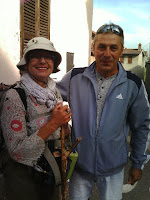
d register, get a town seal or stamp (very important for pilgrims), and sign the guest book. A few minutes later, Sandro appeared. He's a local college professor; bio-chemistry. Sandro offered to buy us coffee and escorted us to the bar where he bought us cappucino and brioche. Now lest you think "bar" like in America, in Italy, a bar is where you go in the morning to grab a cup of coffee, read the paper, hang out and chat over a card game, etc. You can also purchase alcohol there later in the day. But it's really more like a coffee shop and bar rolled into one.
After our delicious break, Sandro escorted us back to via francigena. We continued on along country roads and trails until we reached Pavia. At Pavia, we took a bus (since it was getting unbearably hot in the afternoons) to Santa Cristina.
The next morning as we walked through the little town of Chignolo Po, we were met by a nun who had seen us walking along or had heard that some pilgrims were coming through. She
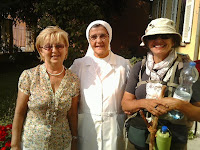
brought us very cold water and had another woman run across the street to get us a stamp for our 'credentiale'. SWEET! When we arrived at Orio Litta, the mayor, Pierluigi, met us, talked about the town, explained our accommodations (which lacked a kitchen but were very nice), then offered to meet us the next morning to walk with us for the first 3km toward the ferry. We wanted to take the more direct autostrada, but were told that it was impossible. Road construction just outside of Piacenza prevented foot traffic across the Po river. So he called ahead for the ferry and arranged our transportation.
On August 19, Pierluigi gave us a short tour of the town as we walked toward the ferry. We said our goodbyes as he pointed us in the right direction. At Corte Sant'Andrea, we were met by a group of locals who offered to stamp our credentials (these are pilgrim passports) and who offered us a
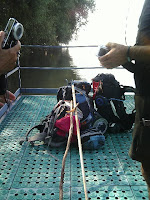
cup of coffee and a nice, cool chair to sit for a while as we waited for the ferry.
They explained that the ferryman, Danilo, was chronically late, so we might as well enjoy ourselves for a bit. So we did.
And they were right. Danilo, who had insisted the day before that the orario (schedule) could not be changed and must be kept, showed up 30 minutes late. But he was funny and hospitable, gave us a stamp as well, took us about 4 km up the Po river (which we paid dearly for- at 10 euros each! that's $15, people, to go 2.4 miles). But it was pleasant and we continued on our way.
Michel went on ahead as usual. And as the day grew hotter, we entered Calendasco. As we entered town, a gorgeous Italian man met us, offered us cold water, brought Sam puppy treats, a package of dogfood for the road, and a huge bowl of water, asked us if we needed anything else, then sent us on our way. A few minutes later, we ran into Michel and his new friend Carlo, who offered to buy us a cool glass of white wine. We chatted for a while and Michel ran ahead.
Then, M-J and I decided to walk to the next town where we would try to catch a bus. We enjoyed fresh figs along the way and found a field of Roma tomatoes (which had already been harvested). There were thousands of ripe tomatoes lying in the fields. We gathered up tomatoes from the ground for dinner that night!
Timing is everything.
In Piacenza, I stopped at the local market to purchase fresh basil and garlic to go with our tomatoes and pasta. We had to change buses. I asked the bus driver for directions to our stop. We had JUST passed it, so he stopped and let us off, pointed us in the right direction, and we trekked back to the "ufficina". The pilgrim accommodation was amazing: washing machine, drying racks, kitchen, chapel, 2 bathrooms and showers, 2 bedrooms with 3-4 beds each: immaculately clean. I think it was a 10 euro donation.
On Friday, August 20th, we walked from Montale (just south and east of Piacenza) to Fiorenzuola d'Arda. The priest met us, showed us to our room, Sam had to stay in the hall. That night, there was a very special ceremony to celebrate the relics of Saint Bernard, complete with a Templar guard and sacred music concert. We joined the town procession and took photos of the relics.
On Saturday, we walked to Fidenza. It was very hot! So M-J and I had decided to try to find a bus at Fidenza. Again, God's timing is perfect. As we stopped near the train station to get a Coca-Cola and to ask about buses or trains, we met Adriana and Marina at the "bar". Turns out, they are both Templars, and Marina spoke French quite well. They wanted us to see the procession that night from Fiorenzuola to the Madonna della Bosche. Marina offered to take us on to Costamezzana, where she also knew another Templar called Oliviando.
At Costamezzana, we were not warmly met, but the old woman agreed to let Sam stay in the old school (pilgrim accommodation). We met Marina again at the local restaurant and talked for hours. Really sweet! We talked about God and faith and what it means to each of us.
On Sunday morning, August 22, we took off early, but were stopped by the old bat (ha ha ha). She threatened to call the police. All because Michel had put the key to the room in the mailbox outside the front door (which is usually what we are told to do). The old woman had obviously missed her calling in life: hospitality just ain't it. When we gave her the key, she calmed down and said, "Va bene. Va bene", and motioned us away.
It was a hard walk that day. Started out cool, but got very hot by 11:00am.
At Medesano where we stopped for a cup of coffee, everyone ignored us until I put Sam's backpack on. Then everyone came over to talk to us, to tell us how to walk on, etc. No one offered us a ride to Fornovo di Taro. So we walked on. When we thought it was unbearable, M-J tried to hitch hike. No one stopped. So we walked on.
Just as I prayed for a cup of cold water, we met Pierra, an old woman who was sweeping her porch. We saw no other signs of life in the sweltering town of Ramilda. She saw us, called to us to offer us water, ran inside, brought two HUGE bottles of cold water, offered us a chair, brought Sammy water, and then ran inside again. This time, she came out with photos which were very sacred to her and began to tell us of the miraculous signs and wonders which had happened at a church not far away.
She told us of her grandson who was 21 and had been burned badly in an accident and asked us to pray for him. Then she offered us tomatoes and peaches from her garden, called her neighbor over and instructed him to take us to the bridge before Fornovo di Taro. I think we all teared up as we said goodbye. It was such a sweet moment. Such an incredible and simple act of kindness which opened all of our hearts!
It took us 30 minutes to cross the bridge over the Taro, because Sam wanted to stop in each bit of shade he could find. It was miserably hot. But we made it across, stumbled down into the town, found a few locals to ask directions to our casa d'accoglienza, and they very kindly offered to drive us there. We accepted!
The casa di spiritualità was run by 2 or 3 nuns from Madagascar. The house was huge, had a gianormous kitchen which we gladly used to cook the pasta we had been carrying in our packs for 3 days, and was clean. They even had seperate rooms for men (Michel) and women (Marie-José and I). Sam was allowed in as long as he slept on the floor.
On August 23, we walked on and took the bus to Berceto. The hills began to get much larger again as we started to approach Pontremoli and the Passo della Cisa. At Berceto, a beautiful village, we enjoyed a last supper together at a local pizzeria.
On August 24, we would go our seperate ways. I was too sick to continue hiking up another mountain pass. By this time, I had been sick with a fever for 3-4 days and had serious respiratory problems. But there were no buses to Pontremoli from Berceto.
So I had to walk another 8-12 km to the town of Ghiare di Berceto the next morning. There was a bus at 8:47am to Borgo, where I could change to a train to Pontremoli.
As I left at 6:30am, Marie-José and Michel and I said goodbye. It was a sad moment, but I knew I could not climb. As I walked to Ghiare, I prayed that God would help me. I felt sick as a dog, ready to pass out at any moment, but had no choice. I needed to walk on. So I prayed that if I couldn't reach the bus in time, that God would send us help, a ride.
Literally, 1 km from town, a man stopped, turned around, and came back for us. He asked me where I was going. He said you are only a kilometer from town, but I'll take you to the bus station. When we arrived at 8:47am, he pointed me to the bar to buy a ticket. I bought the ticket for the bus and train to Pontremoli, stepped out to the bus stop, and 30 seconds later, the bus arrived. No kidding!
We rode the trains all day to get to Siena. At Siena, we took a bus to city centro, walked to our accommodation, but were told that Sam could not come in. He had to stay in the courtyard all night. I met two other pilgrims there: one from Italy, one from Switzerland.
Sam was very quiet until 4am, when he "woofed" softly 2-3 times. He was looking for me. I went out and sat in the courtyard with him until 5:30am. I watched the moon and the morning star until around 5:00am when a heavy haze covered the sky. Fog was rolling in. Thick, pea soup fog covered Siena and Tuscany as we made our way back to the train station where we would take a train to Monteroni d'Arbia, then walk 7 km to Campriano.
By the time we reached Campriano, the fog had burned off and it was a scorcher. We ran out of water before we reached Campriano, and Sam was searching for every shadey spot to rest.
As we reached Campriano, we were warmly greeted by Claudia who ran to get us cold water.
I rested for 3 days, took one day to run back in to Siena to get Sam groomed, and slept, did laundry, etc. No internet there. But enjoyed the views and short walks each day.
Sunday, August 29- We walked on to Ponte D'Arbia where I had reserved a bed. It was a beautiful Sunday morning and we had left at 5:30am to avoid the heat. We walked by moonlight for a while, were surprized in the dark by a small, wild hog, and enjoyed the rolling countryside. As we left Campriano in the dark, early morning hours, trekking along a dirt and gravel road, the superfine dust of the area, called Sienese Crete, rose in clouds from every step we took. Within only a few yards of walking, we were covered in a fine, powdery, silvery dust. As we wound our way through the hills, it seemed we could see Campriano from almost every bend in the road. Just 2 km shy of Ponte d'Arbia, Carlo stopped to take us on the rest of the way. He had just been to the local thermali, or hot springs. He apologized for the sulfur smell, but assured me that it is great for the skin. He goes there every Sunday morning, it is his ritual. He chattered away in Italian, telling me all about the local history and sites.
At Ponte d'Arbia, we met two French pilgrims: Denis and his 80 year-young mother. She had already walked Saint Jacques de Compostelle and wanted to walk another pilgrimage in her lifetime, so she was doing it.
The next morning, we enjoyed coffee together at the local bar before taking off. I strolled along, taking photos, and giving Sam rest breaks. We continued on to San Quirico d'Orcia where we could not stay at the Parrocchia, so we stayed at an albergo (a roadside motel/ truck stop). It was very clean and I had a bathroom to myself.
I met Cristiana and Andrea at San Q, a couple from Siena.
I took the more direct route along the via Cassia or the SS2 highway. More cars, more dangerous at times, but definitely much shorter. It was a very narrow, two lane highway with sharp drop offs from the asphalt and trees growing right up to the edge of the road. Somewhere along the way, I saw a sign for VF so I decided to leave the highway and try the quiet country lanes. I ran into Cristiana and Andrea again on the trail. From a distance, we saw Denis and his mom ahead of us, but they must have had a different map, since their route crossed over fields. We quickly lost sight of them again and headed on to Gallina where we hoped to catch a bus to Radicofani.
Too hot for Sam, and poor Cristiana had blisters the size of Texas on her feet. We waited for 3 hours to catch a bus...which would still leave us 8 kms shy of Radicofani. So we still had to hoof it in the heat.
But we found fresh blackberries along the way, took our time, and climbed up to Radicofani. It was beautiful! I
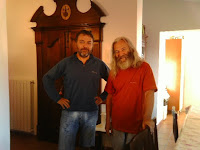
waited for about 20 minutes for the
fratelli to arrive. They don't accept dogs, but they made an exception as long as Sam slept on the floor.
Our reception was amazing that night. Michaele and Don Giovanni welcomed us, made us dinner, they even washed our feet and prayed for us! The next morning, they made us breakfast and prayed for us again. The dinner conversation was sweet. Don Giovanni has a beard like Merlin, a deep voice which resonates, and an amazing ability to bring out everyone's story. He listens keenly and just oozes compassion and life and joy. Michaele was also serving for one week at this house for pilgrims, volunteering his time to cook and wait on others and pray for them. It was a very moving experience to have these two brothers in Christ serve us, because they said, "Jesus came to serve, not to be served. He is our example."
Radicofani sits high above the plains and is a gorgeous town with a castle. It was cool there, a refreshing mountaintop island above the sweltering plains. You can see the castle tower for miles and miles. I still saw it this morning as I crossed toward Bolsena.
From Radicofani, we descended for 11kms along a gravel road. Very slow and hard going. Downhill on gravel= slippery slope. We took a small break along the way, then continued on to Acquapendente, where I met Alessandro just a few km from town. He offered us a ride. As usual, I accepted because it was getting too hot for Sam. Alessandro took us on a tour of his family farm and organic orchards.
He also took me to the convent where they would not accept dogs, but I had another place to call. So Alessandro called for me, secured a bed, and there I ran into Cristiana and Andrea again.
Alessandro invited me to dinner, so I accepted, met his parents, enjoyed dinner at the farm, where they do not live but have a summer kitchen and wine cellar just for family gatherings. Alessandro wanted to talk business. He wants me to bring back a group of Americans next year to tour the area. It is really lovely here with tons of things to do and see. He convinced me to stay an extra day so I could see the churches, cathedrale and crypts beneath the cathedrale. Then he took me to the thermal baths or hot springs at Saturnia. I think I still smell like sulphur, but my skin does feel better!
This morning, September 3rd, I walked from Acquapendente to San Lorenzo Nuovo. It's starting to cool off a bit, but the afternoons are too hot for Sam. So, we stopped for a cup of coffee for me and bite to eat and a drink of water for Sam at a local cafe, where we met Leonnia, an older woman from the area who owns a large house with 600 olive trees. We talked for a while, then she offered to take me on to Bolsena, only another 10 km. She really enjoyed finding this place; the ex-convent is set up for pilgrim accommodation. I have to say that Leonnia was impressive. At 80-something years
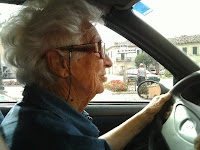
old, she drove a standard transmission like a pro, stopping on hills, asking directions, and exploring the area around Bolsena. She said she loved it because she had never been up this road before.
The former convent sits high on a hill, even above the local castle, with an incredible view of the Lago di Bolsena (the lake) below.
Stay tuned for more... I'll be including my top 10 travel trips in the next blog. Tomorrow, we walk on to Montefiascone. Sunday, September 5 (my sister, Cyndi's birthday)= Viterbo. Monday, Sept 6 arrive Vetralla or just beyond. Tuesday, Sept 7= Capranica. Wednesday, Sept 8 a very short walk of 6 km to Sutri. Thursday, Sept 9= Campagnano di Roma. Friday, Sept 10 (my niece, Sarah's birthday) arrive La Storta. And Saturday, September 11 we walk the final 10-12 km to Rome and Saint Peter's Square.

 Over the next couple of weeks I'll reveal my arguments for hope and the power of love in a series of letters to my niece. This stems from my conception of an assignment at university for a class on ethics. As I struggle to understand various reasons for sustainability, unsustainable behaviors and attitudes, war, conflict, and peace and to understand my fellow human, I cannot rid myself of my eternal optimism. I've been accused more times than I can count in my adult life of being "unrealistic", as though only a pessimist sees the down side of life and that a pessimistic view is a "realistic" view. But in this series of letters to my niece, I will argue that transcendence of the human spirit is the hope for our future and for future generations.

 Tales of a Female Nomad - Living at Large in the World by Rita Golden Gelman (2001)
 The Hidden Reality- Parallel Universes and the Deep Laws of the Cosmos by Brian Greene


