This tiny tune was created for the Eucharist, as a way of celebrating the tangible expression of Christ’s love in a physical world. Eucharist is one expression of the connection between form and formless, spirit and material world, the universal Christ who is in all and through all.

The Happy Snowflake Dance blog; a daily exercise in openness meditations. The 21-day Happiness Experiment has morphed into a 21-day Openness Experiment. My Mission: a daily journey into openness through meditations, words, actions and being.
Wednesday, March 17, 2021

Minor hymn for the Scottish Communion
Another short video and interlude created for online church, inspired by Fr. Richard Rohr and Eckhart Tolle. I’m still learning to make music, so my attempts are not professional or perfect. But I do enjoy creating...
Tiny tunes, form and formless, structure and space...
One of the challenges I accepted this week was inspired by Eckhart Tolle’s Freedom From the World conference, in which he described music which allows for the space or stillness between notes. I had always thought of music as just the notes, the structure, the form. But in his description of spiritual music, he pointed out that music is also music because of the pauses, the space between notes, the silence. In that silence or stillness is being.
Just like in the Tao Te Ching, where it mentions that a cup is useful because of its emptiness. If it is already full, it is of no use to me. Its very essence of being empty is what makes so valuable, because then it can receive whatever is needed.
Tao Te Ching 16-
“Effect emptiness to the extreme.
Keep stillness whole.
Myriad things act in concert.
I therefore watch their return.
All things flourish and each returns to its root.
Returning to the root is called quietude.
Quietude is called returning to life.”
And again in TaoTe Ching 11-
“Thirty spokes join together in the hub.
It is because of what is not there that the cart is useful.
Clay is formed into a vessel.
It is because of its emptiness that the vessel is useful.
Cut doors and windows to make a room.
It is because of its emptiness that the room is useful.
Therefore, what is present is used for profit.
But it is in absence that there is usefulness.”
So, in my first attempt to create music which honored the space between the notes, I wrote this little interlude. I suppose if it needs a title, I would call it...Sunday Lament.
Music inspired by Tolle and Rohr...
Inspired by both the writings and teachings of Father Richard Rohr and Eckhart Tolle this week, I’ve really enjoyed creating new music, or as my sister calls them “Tiny Tunes”. Written specifically for interludes in our little Episcopal church online forum, these little songs are usually around 30 seconds long, sometimes as long as 1.5 minutes.
Monday, March 15, 2021
The balance of form and formless, movement and stillness...
“The natural world is its own good and sufficient story, if we can only learn to see it with humility and love. That takes contemplative practice, stopping our busy and superficial minds long enough to see the beauty, allow the truth, and protect the inherent goodness of what it is—whether it profits me, pleases me or not. Every gift of food and water, every act of simple kindness, every ray of sunshine, every mammal caring for her young, all of it emerged from this original and intrinsically good creation. Humans were meant to know and enjoy this ever-present reality—a reality we too often fail to praise, or maybe worse, ignore and take for granted. As described in Genesis, the creation unfolds over six days, implying a developmental understanding of growth. Only the seventh day has no mention of it. The divine pattern is set: Doing must be balanced out by not-doing, in the Jewish tradition called the “Sabbath Rest.” All contemplation reflects a seventh-day choice and experience, relying on grace instead of effort. Full growth implies timing and staging, acting and waiting, working and not working. All the other sentient beings also do their little things, take their places in the cycle of life and death, mirroring the eternal self-emptying and eternal infilling of God, and somehow trusting it all—as did my dog Venus when she gazed at me, then looked straight ahead and humbly lowered her nose to the ground as we put her to sleep. Animals fear attack, of course, but they do not suffer the fear of death. Whereas many have said that the fear and avoidance of death is the one absolute in every human life. If we can recognize that we belong to such a rhythm and ecosystem, and intentionally rejoice in it, we can begin to find our place in the universe. We will begin to see, as did Elizabeth Barrett Browning, that “Earth’s crammed with heaven, And every common bush afire with God.”

From Richard Rohr- The Universal Christ- How a forgotten reality can change how we see, hope for, and believe.
From Stillness Speaks by Eckhart Tolle: “Feeling the oneness of yourself with all things is love.”
Other quotes from Tolle’s Stillness Speaks:
- “In the Bible, it says that God created the world and saw that it was good. That is what you see when you look from stillness without thought.”
- ‘To be still, look, and listen activates the non-conceptual intelligence within you.”
How do we recognize beauty, truth, or goodness? Are these just cultural concepts, human concepts that must be taught with words? Or do you recognize beauty when you see it, without words, beyond thought? This is what Tolle means by the non-conceptual intelligence within you. There is a wisdom, a spiritual “truth”, an elegance in the universe which resonates with you, without needing words to actualize or describe it. You just know it. You feel it. You recognize it. You sense it in the form of a tree, without naming the tree, the species, the genus, without enumerating the particulars, and yet at the same you feel the rootedness of a tree which does not strive to be. You feel its inner beauty, without form. And at the same time, this formless presence gives shape to the form in front of you. This is the wisdom of love in the universe. This is the wisdom of the formless, eternal presence, the I Am that I Am at work in us and through us and for us, drawing us deeper into grace, into love, into the universal Christ.
As I’m listening to Eckhart Tolle’s retreat, Freedom From The World, on Audible.com, I am reminded of a sermon I heard years ago when I attended a Chinese Baptist church outside of Tulsa, Oklahoma. Yep. You read that correctly, a Chinese Baptist church in Oklahoma. I hope you giggled a little at the thought. I still do. I loved those people.... The services were bilingual. But back to the reminder, the pastor of the church had been a Tai Chi master in Singapore. One Sunday, after quite a few of us had been up all night playing cards and games, he chided us gently to live a life of balance. Tai Chi is all about balance, he said, and our call to spirituality is all about balance, not about perfection.
As Tolle discusses in the 3rd session, or Chapter 3 on Audible, music which pulls us into the spiritual dimension points to a balance between form and formless, structure and space, notes and silence. As I let this concept sink in today, I feel like I want to try to create music this week which honors that balance between structure and space, form and formlessness. Can I give more space to the silent parts of a song? It’s a challenge in which I find joy and delight. It’s not something I feel compelled to do, in the sense of obligation, but in the sense that I feel pulled toward. Does that make sense?
I recognize that what Tolle is saying is only a pointer, it is not ultimate truth. Keeping this balance between ideas or concepts, which are only forms, and true spirit which is formless, is key. Again, the old Buddhist saying that “the finger pointing at the moon is not the moon” hints at this revelation. Can a “spiritual song”, that is, a song that pulls me toward oneness with Being be birthed through me, this form that I have right now? It will be fun to explore this. Will the product of this exploration, i.e. the song, have meaning or impact on others? Who knows? And ultimately, that probably doesn’t matter at all.
Oh, the monkey brain...right? This also reminded me of singer, musician extraordinaire, and songwriter, Michael Gungor, formerly of The Gungor Band, Gungor, the Liturgists Podcast, author of the book, This, and now known as Vishnu Dass. Watching his transformation over the years, since he was a teen leading worship at his dad’s church in Oklahoma, gives me incredible HOPE for this new generation. I still love his old music from the early days, and I’m excited to see what will continue to come into the world through this open, ever-questioning, mystic musician. I hate to categorize him as just a musician. He and wife Lisa are obviously so much more. Even the word “mystic” is limiting. I’m looking forward to what comes from them next.
It took me 50 years to wake up. That’s why I have such incredible hope in this younger generation. They are already so much more “woke” than I was at their age. Even my 15-year old nephew is incredibly “woke”, that is, less tied to the world of forms, less attached to the ideas of forms that we often put on each other. I can see that he and some of his friends are already less attached to the labels we put on ourselves and others: Christian, conservative, gay/ straight/ Bi, male/female, American, black/ white, etc. And this in a group of kids who are going to a private “Christian” school. The fact that they are already challenging their assumptions of how the world is “supposed to be” comforts me. It’s encouraging to see my nephew already open to the perception of form and formless.
And now, I am going to practice stillness for a bit with Tolle. Maybe this will seep into my music, maybe not. I’m okay with that, too.
Sunday, March 14, 2021
Thoughts on time and freedom...

“But there is something about Time. The sun rises and sets. The stars swing slowly across the sky and fade. Clouds fill with rain and snow, empty themselves, and fill again. The moon is born, and dies, and is reborn. Around millions of clocks swing hour hands, and minute hands, and second hands. Around goes the continual circle of the notes of the scale. Around goes the circle of night and day, the circle of weeks forever revolving, and of months, and of years.”
- Madeleine L’Engle
I have always loved to think about time. When I was a young reader, I read L’Engle’s trilogy on time and space travel, beginning with A Wrinkle in Time. It’s fascinating, thinking of tesseracting. As an adult, I loved L’Engle’s personal journals in which she celebrates the passing of seasons, and embraces the moments that seem to define our lives; birth, death, and all the ordinary moments in between. I love the feeling of grounded-ness in her approach to those ordinary moments, lived out as extraordinary worship, connection to God, reflection of the one life lived now in this temporary form through the celebration of chaos, glory, entropy, exhilaration, banality, and decay.
And yet, the only time that ever actually exists is now, this present moment. Future and past are illusions of the mind. Only now ever exists. As Tolle points out often, if I remember the past, I am remembering it now. If I think of the future, I am thinking of it now.
And when I get caught up in reaction to others or life or something I did or didn’t do, I lose touch with the present moment. I forget to be at peace with reality. Reality is only ever NOW.
I was reminded of Eric Fromm’s groundbreaking work, Escape from Freedom, as I exam my own mind structures and episodes of fear or judgment. If you are not familiar with his work (or that of Hannah Arendt), here is the blurb from Amazon about the book: “Why do people choose authoritarianism over freedom? The classic study of the psychological appeal of fascism by a New York Times–bestselling author.
The pursuit of freedom has indelibly marked Western culture since Renaissance humanism and Protestantism began the fight for individualism and self-determination. This freedom, however, can make people feel unmoored, and is often accompanied by feelings of isolation, fear, and the loss of self, all leading to a desire for authoritarianism, conformity, or destructiveness. It is not only the question of freedom that makes Fromm’s debut book a timeless classic. In this examination of the roots of Nazism and fascism in Europe, Fromm also explains how economic and social constraints can also lead to authoritarianism.”
It explains so much of the last 5 years in America and the cult of Trump.
That is not a judgment. It is a reminder to me that we humans constantly look to externals (life situations, leaders, others, possessions, etc) for a sense of peace, safety, or identity, a sense of self.
Of course, external, temporary forms cannot truly fulfill us. As I listen to Eckhart Tolle’s Freedom From The World retreat on Audible, I am aware of my own descent into ego structures this week.
I love this first reminder from Tolle, “you are not upset for the reason you THINK you are”. You are upset because you have lost touch with the present moment and your oneness with all of life. To be in touch with the oneness that you are with the entire universe is to enter into abundant life. To accept this moment, life, reality as it is is to be at peace with now. You are the formless, timeless one life in the universe, not just this temporary form of body and mind and emotion.
At the same time, this temporary form is a part of who I am now. So I don’t reject my body form or even all these thoughts which pass through my mind. When I am one with this moment, accepting life as it is, I am able to see that thoughts are not ultimately me. They are just forms which are passing through. They can also serve a purpose, but they are not my identity. We lose ourselves when we try to grasp or cling to externals as our identity, or when we see “them” (externals) as the “problem”.
Yesterday, I totally devolved into the old ego self, or as the New Testament calls it “the carnal self”, for those who still speak Christianese. I was upset about something. Someone didn’t do something the way I thought they should and it made a bunch of work for me. At least, that was the story I kept telling myself. And the more I told my story to myself (and anyone else who would listen) the more it became entrenched in me. It was a classic case of the Velcro/Teflon theory of neuroscience, how the brain loves to cling to “bad” stories and how it so easily lets “good” stories slip away, like cheese on a hot Teflon pan.... My brain was running away with this story of inconvenience. Soon, as it often does when we tell and retell stories, the hours that I spent fixing this “problem” were inflated. Like an old fish tale about how big the fish really was, it kept growing with each retelling in my head. Soon, I had convinced myself that I was on the verge of burnout.
Yes, I totally let my ego take over, trying to inflate my sense of self and self-importance in this little drama that was running in my head. I was upset most of the day, even when I caught myself repeating the drama, and I was able at one point to say, “okay, this is the story I am telling myself right now”, I was still caught up in the emotion of being “a victim”, of vociferating the injustice of reality, of the “how dare that guy make me have to do so much work to fix his mistake?”
And then, I listened to Tolle on Audible, starting with this little pointer: “If you are upset about something, you are not upset for the reason you think you are.” You think it is because someone did or did not do something, or that life is not the way you think it should be. Or maybe you think you are upset because YOU did or did not do something that you should or should not have done.... Nope. You are upset because you have lost touch with BEING in this moment, now. You lost sight of this present moment. Because if you and I could live in the present moment, we would recognize that reality or life is as it is. Life happens. It cannot be otherwise (as Tolle often says). So why am I upset? I’m upset because I am in conflict with the present moment. I’m either living in the past or obsessing about the future. Past rehashing looks like: “He should not have...or She should have...Or Why did I do...?” Groan! Future obsession looks something like this: “If only I could...If only I had... or If only I were..., THEN, I’d be __________ (fill in the blank: happy, fulfilled, rich, enough, loved...)”.
When I am at peace with what is, and that’s reality, (for the pragmatists or realists in the group), when I accept this moment or life as it is right now, I am not upset. I am not disturbing myself. When I accept what is happening now without reaction, without judgment, I am at peace, because I am one with reality. Not some imagined future, not some judgment about the past, eg. “He should have...she should have...They should not have... Life is not supposed to be this way...I should not have...”. But when I accept what is, because life is as it is, then I enter into oneness with all of life, with God. AND THIS IS FREEDOM! Freedom from my sense of self, freedom from the compulsion to defend my “victim” self or the compulsion to make myself superior, freedom from judging others, freedom from fear, anger, bitterness, etc.
If I am upset, it is not for the reason I think I am upset. It is not some external stimulus that has created the drama in me. It is my own internal dialogue which creates the “upset”.
So, I am learning. I am beginning to wake up to spirit self more often. Sometimes, I can quiet the complaining mind quickly, immediately. Other times, it takes over and runs my brain for a few hours...until I remember to ask myself: Do I WANT to be upset, unhappy, or angry? Do I WANT to be the source of drama for myself and others? Or do I want peace? Peace chooses to accept life as it unfolds. If I am upset, it is not for the reason I think I am upset. It is not some external stimulus that has created the drama in me. It is my own internal dialogue which creates the “upset”. I can choose to be miserable or I can remember to reconnect to this moment, now, and accept what is. When I accept the “isness” of this moment, as both Tolle and Meister Eckhart call it, I can act out of a place of calm being. Okay, so the music needs to be edited, that’s fine. I will work on it when this moment calls for me to do so. And then when I am in the moment of “working mode”, I can address the issue calmly, rationally, without judgment or reaction. I can even work on it with joy or enthusiasm. I no longer see the is-ness of life as a “problem to be fixed”. Life is as it is.
Ahhhh. Thank God for Meister Eckhart, Eckhart Tolle, and others who are shining a light for me to see the world differently.
Monday, February 1, 2021
Thoughts on Richard Rohr’s “The Universal Christ”
Thoughts on Richard Rohr’s “The Universal Christ”:
“in Christianity, we have made the mistake of limiting the Creator’s presence to just one human manifestation, Jesus. The implications of our very selective seeing have been massively destructive for history and humanity. Creation was deemed profane, a pretty accident, a mere backdrop for the real drama of God’s concern—which is always and only us. (Or, even more troublesome, him!) It is impossible to make individuals feel sacred inside of a profane, empty, or accidental universe. This way of seeing makes us feel separate and competitive, striving to be superior instead of deeply connected, seeking ever-larger circles of union. But God loves things by becoming them. God loves things by uniting with them, not by excluding them” (Rohr, chapter 1).
“God loves things by uniting with them, not by excluding them” (16).
What does God want to do in this world through me? Through this temporary form? I feel there is some purpose, but I am floundering. If this world and all its visible forms are only temporary, what is the greater invisible purpose? Is it useless then to strive for fulfillment in this lifetime? No. That is a pessimistic view, an apathetic view. This finite world, this finite existence with all its temporary forms still reflects the formless, invisible, infinite universe of deep spirit. Paul had glimpses of this deeper reality at times. Romans 1:20, “For since the creation of the world God’s invisible qualities- his eternal power and divine nature- have been clearly seen, being understood from what has been made, so that men are without excuse.” Or Hebrews 8:5, when talking about the tabernacle, the writer points out that it is based on template from the invisible (spirit) universe—“They serve at a sanctuary that is a copy and shadow of what is in heaven. This is why Moses was warned when he was about to build the tabernacle: ‘See to it that you make everything according to the pattern shown you on the mountain.’” And Hebrews 9:23-24, “So it was necessary for the copies of the heavenly things to be purified with these sacrifices, but the heavenly things themselves with better sacrifices than these. For Christ did not enter a man-made copy of the true sanctuary, but He entered heaven itself, now to appear on our behalf in the presence of God.”
II Corinthians 4:18 reminds us that this world is temporary, only a shadow or a poor copy of the spirit world—“So we fix our eyes not on what is seen, but on what is unseen, since what is seen is temporary, but what is unseen is eternal” (NIV). Jesus the Christ continually reminded people that he was not of this world, his kingdom was not of this world. This world is only a temporary copy of the real thing, the eternal world which is held together in the very being of the Christ. Jesus was just the Christ’s temporal, earthly form in a specific moment in time. But the Christ is eternal. He is the LORD, that is translated as Yahweh, the I am that I am, the nameless, formless, eternally existing outside of time God, divine spirit, divine presence, the light of the world, life itself in whom ALL things exist and from whom nothing can ever be truly, completely separated. See Romans 8:38 again. For I am convinced that NOTHING in the entire universe can separate us from the love of God that is in The Christ. Why? Because the Christ is in all and through all. Nothing can exist outside of the Christ. The entire universe is held together in his being.
I am convinced that the separation from God arises in the mind, in the ego-self, in our mind made constructs, our identities or those things to which we uselessly cling to define ourselves. Adam and Eve is a myth with keen insight into this differentiation from Spirit God. When they ate from the tree of the knowledge of good and evil, they suddenly had an awareness of self as separate from God. Before that, they were one with God. It is precisely this egoic self that continues to divide us. Jesus understood this. In his great temptation, we see that each encounter or temptation was a temptation to define self, defend his sense of self, to embrace the ego. “If you really are the Christ...” is a total attack on his identity self. Yet, in his first sermon, Jesus taught that the egoless (the meek) will inherit the earth. Can we die to self as he taught over and over again? Can we give up defending a preconceived idea of who we think we are or should be or who we think others are? Can we give up judging? That is the egoless self of Christ. Years before he went to the cross, he had already “died to self” or chosen the egoless life. And that is the very path he has shown us.
So, though this world is temporary, what I do, or rather, how I do is important, too. Again, I keep getting caught up in the “what” rather than the “how”... what’s that saying? “How you get there is where you arrive”. Let that one sink in.
How you get there is where you arrive.
When I make it my goal to be a better person, I’ve already turned that good quality into an object. “Goodness” becomes the object. But true spirituality is not about the goal or object, it is about the subject. We only get to the “subject” state by being. Jesus got this. James said, “Don’t just be hearers of the word, but doers” (James 1:22). Even this view is problematic, in that it only gets to half of the truth. Jesus’ most critical teachings in Matthew 5-7 get to this point. Just doing is not the answer either, especially if your doing is to gain applause or build your ego in some way. Even the Pharisees did all the right things, right? So making it my goal to be seen as good by doing all the right things is not the answer. The “how I am in the universe” is more useful than who I am (trying to define infinite self with finite labels) or what I do (object). The “what I do” becomes an object when I make it my goal, rather than letting my doing be a byproduct of my joyous being now.
Everything that Jesus the Christ pointed to was about being, now. Being. Now. Being goes beyond thought. Being exists without labels. In our very frail, human state, we seem to constantly try to label everyone and everything, “good, bad, pretty, ugly, nice, mean, awful, wonderful, Christian, Muslim, gay, straight, male, female, old, young, tree, rock, dog, cat, evil, saint, us, them....”. Judging. Constantly labeling in our minds. This is what the Tao Te Ching meant when it says, “All in the world recognize the beautiful as beautiful. Herein lies the ugliness. All recognize the good as good. Herein lies evil” (TTC 2). Labeling is judging. As though a word could describe all the wonder and glory that is wrapped up in each intricately formed being or object in this universe which is also intricately connected to the whole and is a part of God. Yes, even that hateful, despicable guy that Jesus told you to love, even if he mistreats you, he is connected the wholeness that is God. He may not know it. And that not knowing is his own disconnect, the very thing that drives him to be the way he is- fearful, hateful, angry, bitter.
Ahhhh, so this brings me back to my question earlier. What is my purpose in this temporary, fleeting world? My purpose is to find the universal Christ in everyone and every thing. Only then can I let go of judgment, of my own ego, and embrace being now. Only when I see the “weight of glory” (C.S. Lewis) can I love my enemies or my neighbors as myself. When I love and stop judging everyone and everything, I finally begin to understand Rohr’s point above that God does not exclude, but unites himself to what he loves. True religion never excludes but becomes ever more inclusive. Religion is pure when it connects us to the whole, not when it divides us into us and them, believers v nonbelievers, good v evil, Christians v Muslims, republicans v Democrats, Protestant v catholic, straight v homosexual. Jesus made it clear that Heaven is here now (Matthew 3:2, 4:17, 6:25-34, and 10:7) and that thinking that heaven is in the distant future or that it is a continuation of this time bound world with its labels and hierarchies completely misses the point about everything he stood for (see Matthew 22:30 and Galatians 3:28).

As Rohr points out in the quote above, the early church got this. They understood in a deep knowing, beyond words kind of way, that getting everyone to believe in Jesus the human as the son of God was not the point. Trying to convince everyone to believe in Jesus was never the point. They understood that as long as we continue to cling to our egoic identities, we separate ourselves from Christ who has always been and is in all and through all and without whom nothing in the universe exists. Jesus Christ did not come to start a new religious sect. He came to show that he is the Christ and that we are a part of him. He came to show us how to see the Christ in every particle of the visible universe. He came to show that we are already the light of the world, that we are already connected to God the invisible, immortal one, that we have never been disconnected except in our minds. He came to show that we have always been in him, that he loves us and is united to us. We just have to wake up from this dream reality which only lasts temporarily.
Monday, January 25, 2021
Reflections on Tolle and the Tao Te Ching

Modalities of awakened doing: from Eckhart Tolle’s A New Earth (final chapter)
Random thoughts and notes from A New Earth.... Ego, with all its desires and “not wants” and lists and judgments does not have to limit or dictate the rest of my existence. Being fully present now in alert attention, not just reacting to everyone/thing around me, aligning with the creative power of the universe around and in me is a different approach to living. This is still less a question of WHAT should I do? And more HOW should I be in the universe? This is about letting go of self (ego, identity with all forms) and finding the universal Christ that is in all and through all. According to Tolle, all three modalities may be in use in any given day.
This is all based on the principle of, at the very least, not doing harm to others.
- Acceptance- inner acceptance of what is, now. This is inner peace. Surrendered action. The only thing I can really take responsibility for is my state of consciousness. PEACE.
- Enjoyment- a sense of aliveness in what I am doing. It’s not about wanting something other than what is. It is embracing this moment as my focal point, and joy flows from that! Joy manifests when I accept and embrace right now, what I’m doing, how I am being. Not waiting for some vague future. Enjoy this moment, this experience. Joy does not come from what we do. Joy comes from within, and because of that, I can enjoy what I do! I will enjoy any activity in which I am fully present or alive. Empowerment and creativity comes when I embrace what I am doing now. Think of all your daily, tedious tasks. Allow them to be the space for alertness, awareness. You are alive! You can enjoy this moment! Find the joy of being in what you are doing. JOY!
- Enthusiasm is creative manifestation . Your outer purpose aligns with inner purpose (awakened consciousness). Deep enjoyment of what is, plus a goal of what you want to do. Energy and intensity with great enjoyment, passion! There is a balance between this joyous energy and the goal. If the goal becomes all important, you become stressed. Enthusiasm resonates with the creative power of the universe. EnTheos= in god.
Enthusiasm does not exclude, use or manipulate others. Enthusiasm gives out of its own abundance. It does not make enemies. Ego cannot exist with true enthusiasm. Peace and joy are at the center of enthusiasm. There is no ego, no identification. Enthusiasm comes in waves. It lifts others around you, too. This is also overwhelming, overflowing LOVE. Wherever real LOVE exists, ego and all its fear-based assumptions cannot exist. This kind of LOVE is what it means to be “in god” (enthusiastic). Richard Rohr says that God unites himself to what he loves (see The Universal Christ).
From Jesus’ sermon on the mount: Blessed are the meek (the ego-less), for they shall inherit the earth. The kingdom of heaven is here now. Utopias/ heaven do not exist in some vague, never appearing future. Heaven exists now in those who awaken.
Other thoughts this week on the wisdom of trees. Lessons in being. Acceptance. Not Striving. Trees don’t strive. They just exist. They grow and bend and sway and sigh and do what they were created to do. We could learn a lot from trees. See Jesus’ words about flowers in Matthew 6. Do not worry about tomorrow. Live now. Be now. Embrace now. A tree with a broken branch does not feel incomplete or strive to prove that it is a tree.
Tao Te Ching- 22: Embracing the imperfect. Imperfection is completeness. There is a beauty in accepting imperfection, like finding the beauty in these broken shards of blue pottery on the ground.

Sunday, November 15, 2020
Sunday at Molly’s
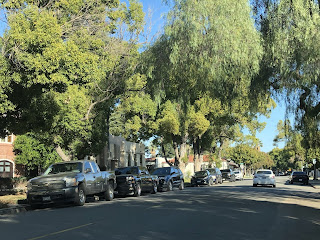
It’s Sunday afternoon in mid-November. I’m enjoying people watching at my favorite local sidewalk cafe in Upland, Molly’s Souper. Molly, the previous owner (she just sold the restaurant right before COVID) whom I’ve always found delightful, is also tuning in to Eckhart Tolle.
Tuesdays with Eckhart Tolle’s Being the Light webinar have been sweet and uplifting. Life is busy, but I’m carving out more time for being creative and also for being present. Wouldn’t it be wonderful to be fully, spiritually conscious at all times? And yet, I’m not. But I find that I catch myself more quickly when I slip into judgmental unconsciousness or being closed. I’m also fully accepting of this fact that life is messy, relationships are messy, and we don’t have to be perfect. Well, let’s face it: we absolutely cannot be perfect. But we’ve never been called to perfection. We have been called to live in peace, to be peace, to walk in light and to be light.
So on this precious Sunday afternoon at my favorite hangout, I’m soaking in the dappled sunlight, glimpses of a sweet puppy at the next table over (only 10 weeks old), street noises, hushed conversations, loud motorcycles, people walking in the soft sunshine, and the gentle strength of several ancient trees lining the streets.
Life is sweet when we allow ourselves to be open to the universe, to whatever is, to this moment. When we turn off the thoughts about yesterday or tomorrow, when we stop listening to fear and judgment, we find that love is there. It is in us. It is all around us. Love flows from us, through us, into us.
Fear leads to anger, hatred, judgment, and so many other negative emotions and actions. It keeps us closed.
But “perfect love casts out all fear.” Fear cannot stand in the presence of real love, unconditional love. We experience that kind of love when we see that we are part of the great cosmic dance, not separate from it, from God, or from “others”. We are interconnected. That is how we can love our neighbors, our planet, other creatures, other people, and our enemies as ourselves...because we recognize that “they” are “us”. We are part of the whole.
Now, I’m headed home to be with family. I hope I can remember this and hang on to inner peace....
Tuesday, October 27, 2020
Being the Light with Tolle

It’s been a busy month. Deadlines for music productions and video productions for online church.
I’ve been enjoying creating new music, such as it is. I’m still learning how to play the piano... well, more like improvise. I just find joy in finding new sounds and exploring with music.
I’ve just started the new Tolle webinar, Being the Light.
Go to EckhartTolle.com for more info. This 8 week series is lovely and filled with gracious compassion.
It’s a sweet, lovely meditation each week. It’s more like a gentle conversation which makes me want to wake up! To be able to face external circumstances from a deeper place of being.
So many thoughts to record... and yet, they are just thoughts.... forms, temporary... Like Tolle, I’ve been contemplating “being light”. I finally get what Jesus was saying about us being salt and light.
I’ll share more on these ideas in future blogs. But I’ve been meditating on what Tolle mentioned last week. 3 things. Jesus said, 1. He is the light of the world. 2 WE are the light of the world. In fact, he pointed out that our essential nature IS LIGHT. “A city set on a hill cannot be hidden”. This isn’t just about doing, but about being. 3. The first thing God spoke into existence was light. We come from light (Formlessness) and we return to light.
But even as we embrace new ideas, we recognize that thoughts and ideas might point us toward truth, but are not ultimate truth. Jesus said you will know the truth and the truth will set you free. What truth? Adopting another ideology? Adopting a set of beliefs? No! Jesus did not come to start a new religion or belief system. He came to point out that we are one with God. We always have been, but our egoic minds create a sense of separation from God, from others.
Like all true spiritual teachers, Jesus simply helped people recognize something inside themselves which they always knew but were temporarily blinded to. You are the light of the world! God is the great I am that I am. He is the Tao (the truth or God) which cannot be described or limited by words or labels. The first precept of the Tao Te Ching is that the Tao which can be described or understood is not the eternal Tao. God is beyond our puny ideologies and beliefs.
Our sense of being-ness comes from the eternal formlessness. This is a call to deeper being. Many wonderful Christians will try to convince us and everyone they meet that we are all going to hell if we don’t put God in their box of beliefs. They think God is like them.
If we agree with them, then suddenly we are worthwhile to them. As long as we agree with their limited, egoic worldview. As long as we identify with their sets of beliefs, then they deem us worthy of going to heaven. But they missed the point of everything Jesus said and taught! Everything for them (and at times for me if I am still operating from my ego self) is about doing, earning God’s love, and nothing to do with being.
I recently had an opportunity to help lead worship with a small group of folks in an open-air setting. It was supposed to be socially-distanced, with masks. I was the only person to wear a mask. They tried to convince me to join them, but I tried to explain that I wear a mask out of love for others. It’s not about fear for my safety. It’s about protecting others from me, as I might potentially be an asymptomatic carrier of COVID-19.
I tried to keep an open heart and spirit as the night went on and people shared their hearts. I wanted to be fully present. But as the night went on, I was saddened to see how much of the talk centered around trying to get everyone to see the world their way. About trying to convince everyone else that they are going to hell... there was very little love, except for people whom they consider to be in their clique.
I kept thinking of Saint Augustine’s words...Preach the gospel by all means, and use words if absolutely necessary. These people were operating from the opposite worldview. Heaven is not here and now or near as Jesus said. Heaven is in a distant future. And by all means talk people to death with your “good news” to convince them that you are “right”, and by default, they are bad or wrong.... and occasionally love people, but only if you think they measure up to your spiritual yardstick.
And I also realize how judgmental this is on my part... and there is the paradox. As soon as I judge others, then I am no longer salt or light. The very thing I “accuse” these others of, losing their saltiness by depending on works, rather than “being light”, is the very thing I am guilty of.... right?
Subscribe to:
Posts (Atom)